
From Career Storytelling to Responsible HR Leadership: Embedding the SDGs in HRM Education
Embedding sustainability within business education requires more than curriculum change. It calls for innovative, reflective and practice-based approaches that connect professional identity with global responsibility.
In this blog, Dr Gráinne Kelly from Queen’s Business School explores how career storytelling, interdisciplinary collaboration and the UN Sustainable Development Goals can be integrated within HRM education to prepare future HR leaders for responsible practice.
Drawing on a recent teaching and learning project, the piece highlights how experiential learning can empower students to see themselves not only as HR professionals, but as agents of sustainable organisational change.
From career storytelling to responsible HR leadership: embedding the SDGs in HRM education
by: Dr Gráinne Kelly from Queen’s Business School, Gráinne currently teaches Resourcing and Talent management and Responsible People Management, grainne.kelly@qub.ac.uk
When I first met Karen Cripps at the 2025 PRME UK and Ireland Annual Conference at Queen’s University Belfast, I immediately recognised the potential of her Career Storytelling for the SDGs masterclass to enrich a new module I was leading in 2026: Responsible People Management on the MSc Human Resource Management programme.
The module was designed around a simple but important question:
how do we prepare future HR professionals to become responsible leaders who can embed sustainability at the heart of people management?
This question underpins the module, which challenges students to move beyond viewing sustainability as a separate organisational agenda and instead understand it as an integral part of responsible HR practice. The cohort of 41 students brings together a rich mix of cultures, nationalities, lived experiences and professional aspirations, creating an international learning environment where discussions about sustainability, inclusion and responsible leadership are informed by diverse perspectives.
That diversity has become one of the module’s greatest strengths, enabling students to explore how the UN Sustainable Development Goals (SDGs) resonate across different organisational, cultural and societal contexts.
In 2026, this vision was further strengthened when I was awarded Queen’s Business School’s Scholarship for Teaching and Learning funding for the project Embedding the SDGs in Responsible People Management Education. This provided an opportunity to develop an innovative, SDG-aligned pedagogical approach that foregrounds sustainability, ethical awareness and social responsibility as core competencies for future HR practitioners.
Rather than teaching the SDGs as a standalone topic, the project integrates them throughout the learning experience. Through structured reflection, SDG mapping, career storytelling and applied learning activities, students are supported to interpret, articulate and embed sustainability-related competencies across key HR functions. The aim is not only to deepen their understanding of responsible people management, but also to help them develop a professional identity as HR leaders capable of creating positive organisational and societal impact.
An afternoon of collaborative, supportive learning
The Scholarship funding enabled the design of an integrated afternoon of learning on 11 June 2026, bringing together expert perspectives on responsible management, sustainability and the future of HR practice.
The afternoon began with Dr Laura Steele, Reader at Queen’s Business School and Vice Chair of PRME UK and Ireland, who explored the importance of sustainability, responsible management and systems thinking in shaping the future of organisations and work.
Building on this foundation, Karen Cripps led her innovative Career Storytelling for the SDGs masterclass. Through reflective storytelling and guided discussion, students considered how their own experiences, values and aspirations connect with the SDGs, enabling them to see sustainability not simply as an organisational objective, but as part of their own professional journeys.
Karen then facilitated a second session, Skills for a Green Workforce Transformation, helping students translate reflection into practice by exploring the strategic role HR professionals play in developing the skills, cultures and capabilities required for a sustainable future of work.
Together, these sessions created a powerful learning journey connecting systems thinking, personal purpose and professional practice. This approach encouraged students to see themselves not just as future HR practitioners, but as future leaders of responsible organisational change.
When circumstances changed overnight
Just two days before the workshops, on 9 June, riots broke out across Belfast. Queen’s University Belfast strongly condemned the violence and made the decision to move teaching online on 11 June to prioritise the safety of students and staff.
Like many educators, this sudden pivot brought back memories of the rapid transition during the COVID-19 pandemic. While we were all better prepared for online delivery than we had been in 2020, it was nevertheless unsettling.
Ironically, the themes we were exploring became even more relevant. The SDGs’ emphasis on partnership, inclusion and peaceful societies resonated far beyond the curriculum.
What stood out most was the resilience of our students. Despite uncertainty, they continued to engage thoughtfully, support one another and contribute generously to discussions. Their professionalism and willingness to reflect on complex societal issues demonstrated exactly the kind of responsible leadership the module seeks to nurture.
The online environment did not diminish the impact of the career storytelling approach. If anything, it reinforced how individual career journeys are inseparable from wider societal challenges, and how HR professionals have an important role in building inclusive, sustainable and resilient organisations.
Student impact
The sessions prompted students to think differently about their future careers and the influence they can have through HR.
One student reflected:
“Future HR leaders have a significant opportunity to bridge these gaps by embedding sustainability and carbon literacy into onboarding, workforce planning and performance management systems. Sustainability is not limited to specialist roles. It is practical, urgent and central to the future of strategic HR.”
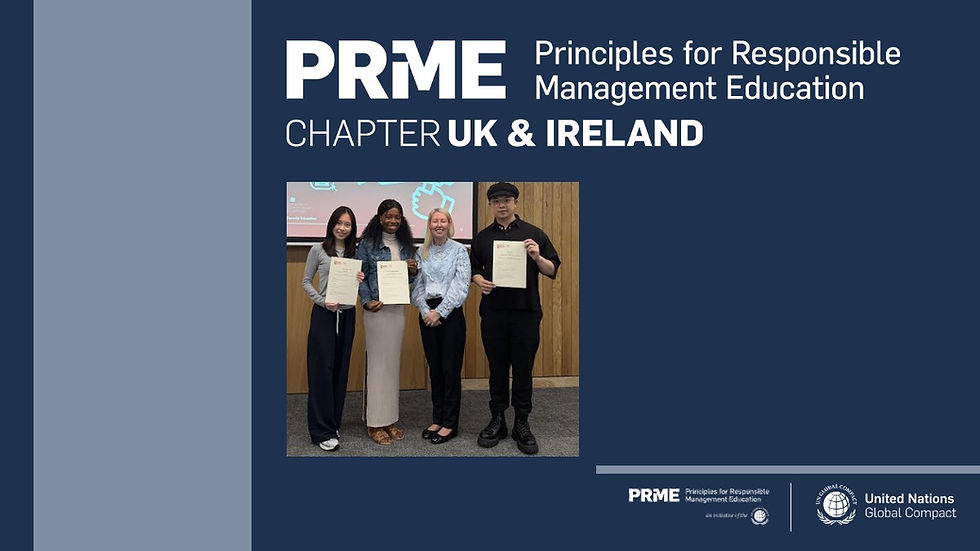
A week later, I was delighted to present students with certificates recognising their participation. During subsequent reflective discussions, it was clear that they continued to draw on the ideas introduced in the masterclass, making meaningful connections between sustainability, responsible leadership and their emerging professional identities.
For me, this demonstrated that innovative learning experiences such as career storytelling do more than enhance engagement. They help students see themselves as active contributors to a more sustainable future of work.
Looking ahead
The collaboration has continued beyond the classroom. Karen Cripps and I are now working with Sarah Williams at Liverpool John Moores University on research exploring innovative approaches to embedding the SDGs within HRM education and preparing future HR professionals to lead sustainable organisational change.
This project demonstrates the value of partnership in reimagining management education. By combining responsible management education, career storytelling and reflective practice, we hope to contribute to a growing body of evidence that equips graduates not only with technical HR knowledge, but with the purpose, confidence and capability to lead responsibly in an increasingly complex world.
If you are interested in responsible management education, HRM pedagogy or embedding the SDGs within higher education, we would be delighted to hear from you and explore opportunities for collaboration. You can contact me at grainne.kelly@qub.ac.uk.


